
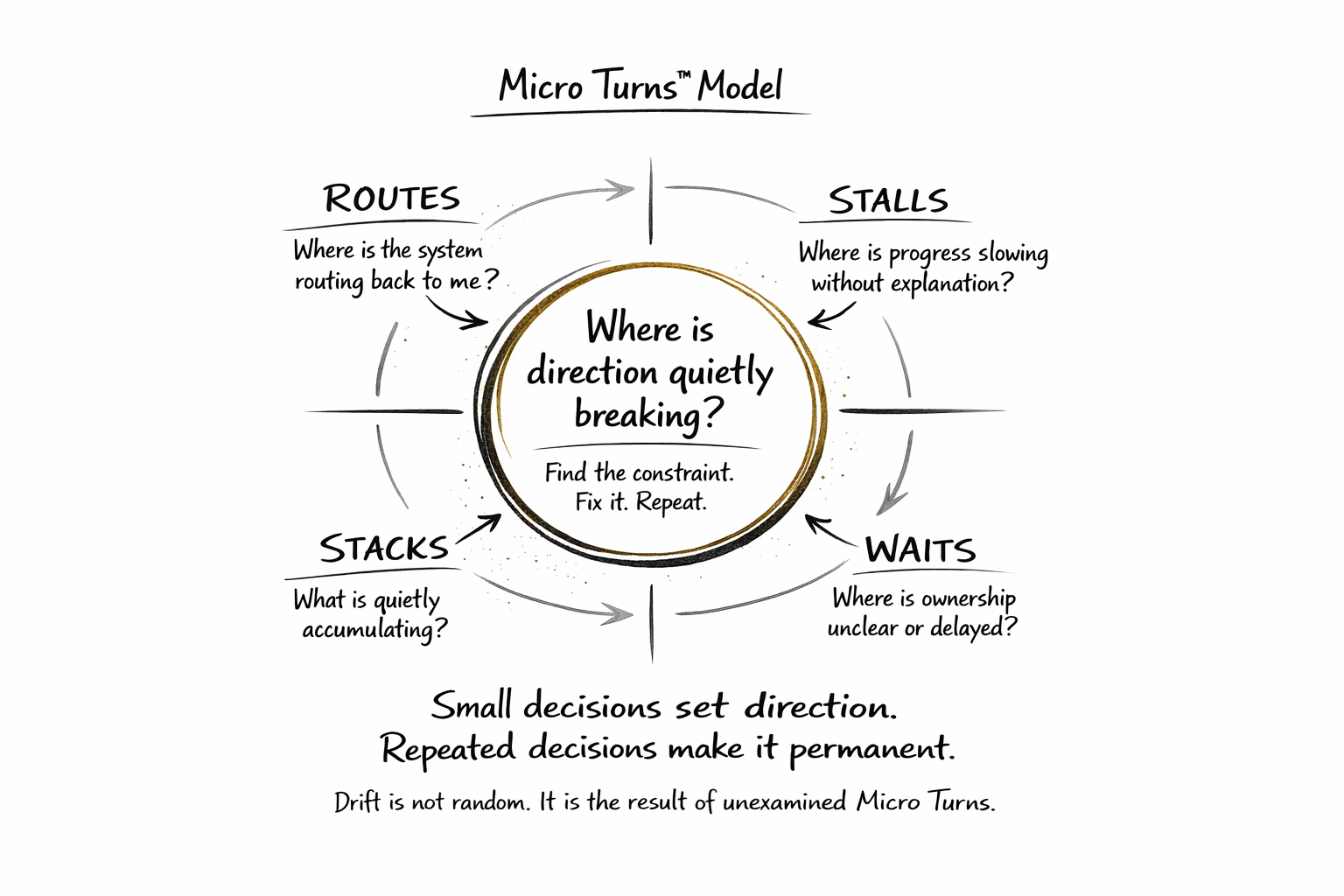
Micro Turns: The Hidden System That Shapes Leadership, Momentum, and Scale
Micro Turns explain why organizations rarely lose direction through a single decision. They lose it through patterns of small, reasonable choices that quietly reshape behavior, momentum, and scale.
The Exposure Threshold Theory
Most leadership failure does not begin with incompetence. It begins with protection.As organizations scale and consequences widen, leaders encounter a subtle but decisive pivot point: the moment when perceived exposure exceeds identity tolerance. At that threshold, authorship contracts. Decisions soften. Authority recenters. Accountability becomes conditional. The organization does not collapse, but distributed capacity begins to narrow.
The Exposure Threshold explains why capable leaders become bottlenecks under pressure and why empowerment efforts often fail despite good intentions. When identity strain triggers protective centralization, agency thins and momentum slows. Raising the Exposure Threshold, however, expands distributed authorship and unlocks the conditions under which greatness compounds.
Unlocking is not motivational. It is structural. Unleashing is not inspirational. It is systemic. Leaders who expand their tolerance for consequence create organizations that move with clarity, resilience, and sustained capacity under strain.

Directional Lock
Directional lock is not the result of stubborn leadership or failed strategy. It forms when direction is reinforced long enough to become structural, and change begins to threaten the systems built to protect it. This article examines how momentum hardens into resistance, why reversal becomes increasingly expensive over time, and what leaders misunderstand about changing direction once organizations have learned what to defend.

Drift: How Organizations Lose Direction Without Ever Deciding To
Drift does not begin with failure or resistance. It emerges when leadership decisions lose durability and direction becomes something people must interpret rather than trust. This article examines how drift forms quietly inside growing organizations, why it often appears during periods of success, and how leaders unintentionally trade clarity for comfort until momentum decays.

Momentum
Momentum is not created by energy, morale, or effort. It forms when leadership decisions are clear, durable, and consistent enough for organizations to stop interpreting intent and start moving with confidence. This article examines how momentum emerges as remembered clarity, why it often outlives leadership coherence, and how leaders misread it until it quietly begins to bend.
How Identity Collapse Creates Decision Drift
Decision drift does not begin with indecision or resistance. It begins when leaders quietly lose authorship over their own decisions. Under pressure, identity fractures, clarity softens, and direction becomes situational. This article examines how identity collapse precedes execution failure and why restoring internal coherence is the highest-leverage move a leader can make.
When Leaders Trade Clarity for Safety
Leadership rarely collapses through poor decisions. It erodes when leaders soften clarity to protect themselves from exposure. Under pressure, safety becomes an organizing principle, quietly rewriting how decisions are made, revisited, and owned. This article examines how trading clarity for safety reshapes leadership behavior, slows execution, and teaches organizations to hedge rather than commit.
Authoring Under Pressure
Leadership rarely fails because leaders lack clarity. It fails because pressure changes what leaders feel permitted to author. As stakes rise, internal conflict quietly reshapes decision-making, leading leaders to soften clarity, diffuse ownership, and prioritize self-protection without realizing it. This article examines how authorship collapses under pressure, why hesitation is not a skill gap, and how leadership integrity erodes long before execution visibly breaks.
Micro Turns as the Mechanics of The Between
Leadership rarely breaks in moments of declaration. It erodes through small, repeated decisions made under pressure, long before outcomes visibly change. Micro turns are the quiet judgments leaders make inside The Between, where clarity, ownership, and tension are negotiated in ordinary moments. Over time, these choices compound, shaping culture, execution, and momentum in ways leaders often don’t recognize until direction has already hardened.
What Breaks in The Between
Leadership rarely breaks where people are looking. It breaks earlier, inside the space where clarity turns into commitment and responsibility turns into ownership. As pressure increases, leaders often soften decisions, absorb accountability, and shorten their tolerance for tension. These shifts feel responsible in the moment, but over time they fracture clarity, diffuse ownership, and quietly change how organizations move. By the time execution slows or culture hardens, leadership has already been operating differently for a long time.